On Rosh Hashana, or during the week between Rosh Hashana and Yom Kippur, it is customary to go to a flowing body of water to perform the ritual known as Tashlich.
The name Tashlich, comes from a verse in the book of Micah in which the prophet declares to God: “vitashlich bimztulot yam kol hatotam”, You (God) will send all of their sins into the depths of the sea”.
For centuries, the ritual has included the throwing of bread crumbs into the water to represent the casting away of our sins. Watching the crumbs flow away from us is intended to make us feel unburdened by the errors of the past year and represent our commitment to change.
But it is interesting to note that the original sources which describe the ritual do not mention the throwing of bread. It seems to be a later development and, in fact, many Medieval rabbis opposed that part of the tradition thinking that it resembled pagan rituals in which people tried to placate the god of the river. Standing at the river and reciting the verse from Micah was sufficient in the eyes of many rabbis.
I agree.
I do not throw bread at Tashlich, but I have found the ritual increasingly meaningful as the years have gone along. I believe that going to the river brings home a critical message. The flowing of the river reminds us that, while none of us know what this year will bring, we do know that we are one year closer to the “mouth of the river” than we were when we performed Tashlich last year.
I believe this is the critical message of the ritual of Tashlich and one of the critical messages of the High Holy Days. We go to the river to realize the passage of time, to see our lives as inexorably moving towards our final day. Confronting our mortality and recognizing the need to return to a proper path now is the most foundational theme of the High Holy Days and seeing the river flowing is a visual reminder of that reality.
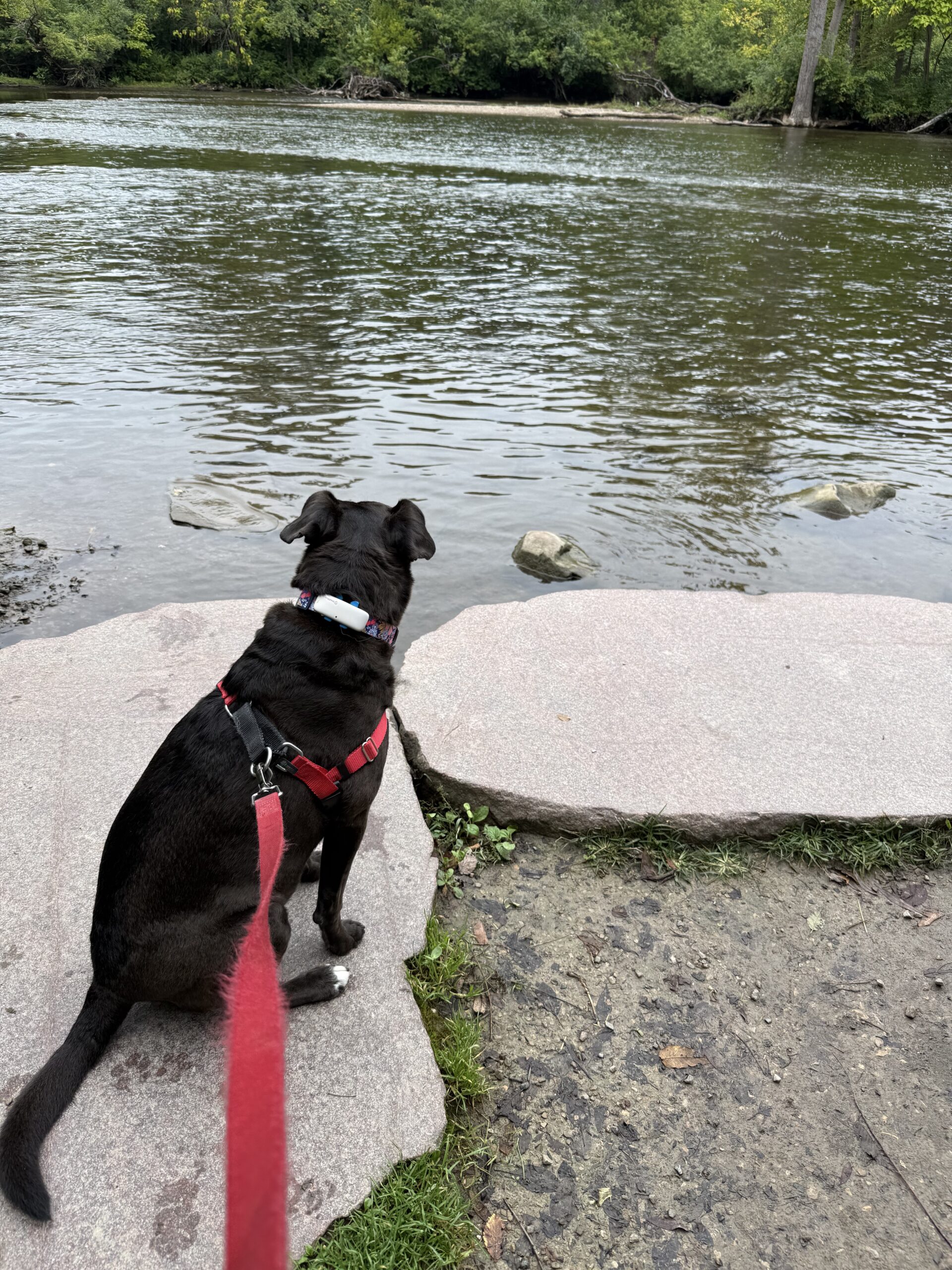
Yesterday afternoon, I went to the Arboretum in Ann Arbor and followed the long trail down to the Huron River. Of course, I took our loyal friend, Millie, along with me and we stood together quietly at the river for a few minutes. I don’t know what my beloved pup was thinking but, as I stood there, a thought occurred to me connecting my understanding of this ritual with a beautiful commentary I once read on a line from the Yom Kippur liturgy. (I regret that I don’t remember where I read it and can not attribute the commentary to its author who deserves all the credit for this remarkable idea).
During the penitential prayers of the Yom Kippur service, we pray to God: “Al Tashlichenu L’et Zikna”. “Do not abandon us in our old age”.
But one rabbi interpreted the word tashlichenu (from the same root as tahslich) as saying to God: “Do not throw us into old age; rather let us age gradually, gracefully and purposefully”
And that is the thought that occurred to me as I stood with Millie watching the river flow.
I am one year older than last year and 38 years older than the day I stood in the same spot performing Tashlich (with bread crumbs then) during my first High Holiday season in Ann Arbor. I am profoundly grateful that I am healthy enough to be able to walk the long path down to the river and feel quite comfortable that I would make it back to the top.
As anyone my age, I have aches and pains and other sure signs of aging but, so far, thank God, I am able to say that aging has come gradually and my most sincere hope for myself as I stood at that river is that I would continue to escape being “thrown” into old age.
I walked away satisfied. I have so much that I hope to see in the year just begun, both on a personal basis and in my hopes for the world. I’ve had time to think about those over these Days of Awe. But, my most fervent personal prayer is that God will guide me towards the mouth of the river slowly and gradually.
I know much of that depends on me, taking care of myself and having the proper attitude. So, I will do all that I can to look ahead with confidence and joy. As the late Jimmy Buffett wrote: “Yesterday’s over my shoulder so I can’t look back for too long. There’s just too much to see waiting in front of me.”
Ken Yehi Ratzon, so may it be God’s will.